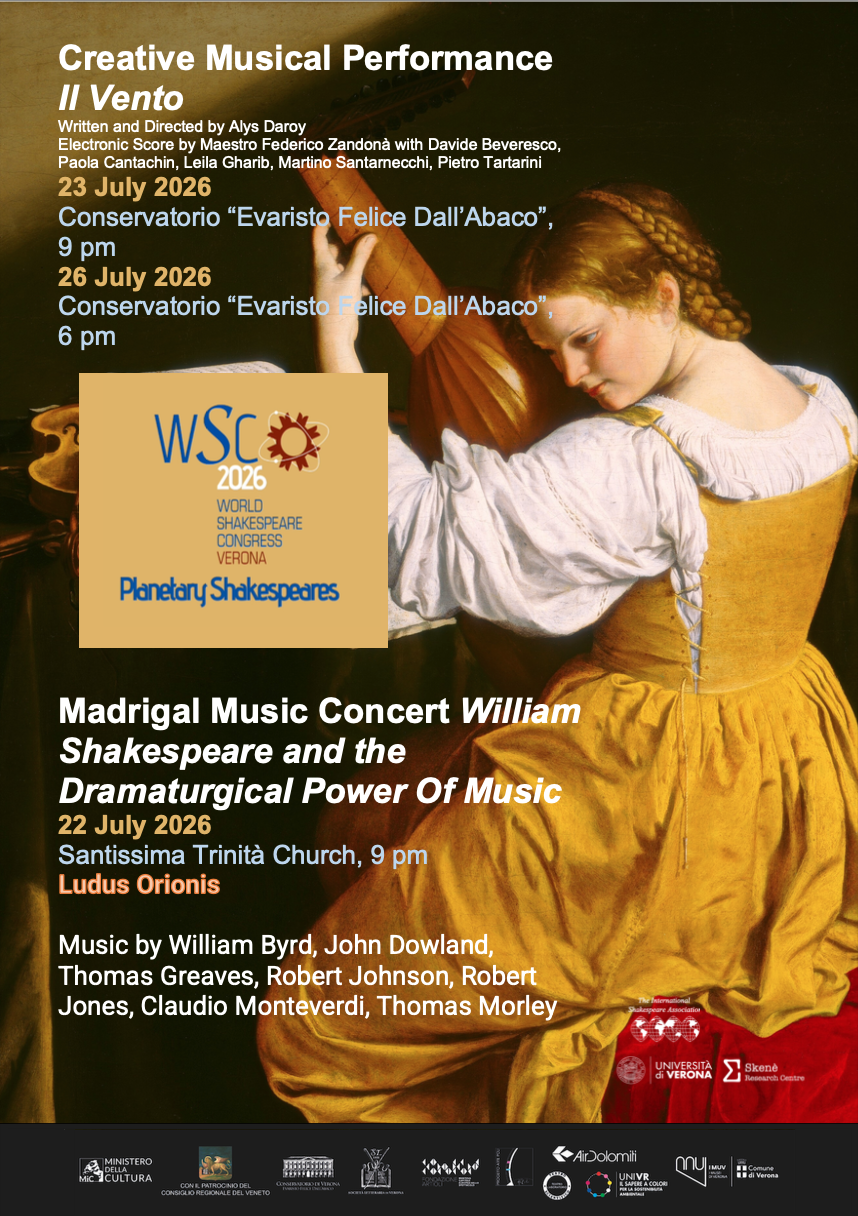
Creative Musical Performance – Il Vento
23 July 2026
Conservatorio “Evaristo Felice Dall’Abaco”, 9 pm
26 July 2026
Conservatorio “Evaristo Felice Dall’Abaco”, 6 pm
Written and Directed by Alys Daroy
Electronic Score by Maestro Federico Zandonà with Davide Beveresco, Paola Cantachin, Leila Gharib, Martino Santarnecchi, Pietro Tartarini
Live Music composed and performed by Michaela Burger
Sound Design by Leo Murray
Scenography by Joshua Zeunert
A storm, somewhere between 1611 and an uncertain future. Miranda, shipwrecked, washes ashore an island where magic and technology blur beneath the watchful eye of Prospero Enterprises. Stranded and pursued, she joins forces with a cantankerous castaway and a resentful logger. Together, they seek the forest’s elusive exile, rumored to remember what the island was before it was owned. But the land is resisting. Its creatures turn restless. A strange music in the air feels hauntingly familiar. Someone, or something, is conducting the elements. Drawn deeper into the isle, Miranda finds herself at the center of a struggle over who controls it—the company that claims it, or the forces that refuse to be silenced. And all the while, Il Vento, the wind, has been listening.
Developed in partnership with Shakespeare South and the Conservatorio di Verona for the World Shakespeare Congress, 2026.
Cast
Caliban — Paul Westbrook
Il Vento — Michaela Burger
Miranda — Melanie Munt
Prospero (voice) — Leo Murray
Sycorax — Alys Daroy

Madrigal Music Concert –
William Shakespeare and the Dramaturgical Power Of Music
22 July 2026
Santissima Trinità Church, 9 pm
Free entry subject to availability.
Music by William Byrd, John Dowland, Thomas Greaves, Robert Johnson, Robert Jones, Claudio Monteverdi, Thomas Morley
Ensemble: 5 singers and 2 instrumentalists (SSATB + harpsichord and theorbo/lute)
Company: Ludus Orionis
The relationship between William Shakespeare and music is both rich and multifaceted. Many of his plays were embellished with songs performed by the actors themselves and accompanied by the lute. Numerous English composers wrote music for such occasions, ranging from William Byrd (1542–1623) to John Dowland (1563–1626), from Robert Johnson (1583–1634) to Thomas Morley (1557/58–1602). This concert offers the opportunity to hear, alongside instrumental pieces, a couple of examples of these songs, some of which were performed within plays such as Twelfth Night, A Midsummer Night’s Dream, and The Tempest.
Structured in four sections – each devoted to a different theme (Love, Torment, Happiness) – the programme includes both instrumental and vocal works by the aforementioned English composers, as well as music by a major composer associated with a land particularly dear to Shakespeare, who set several of his most famous plays in Venice and Verona: Claudio Monteverdi (1567–1643), active as maestro di cappella at St Mark’s Basilica and deeply connected to the flourishing madrigal tradition of the period.
The madrigal is an art form rooted in the heart of European culture, with its earliest examples dating back to the medieval period. Over time, it established itself as the highest expression of the Renaissance synthesis between music and text, continuing into the Baroque era. The most gifted composers of the period – from Jacques Arcadelt to Philippe Verdelot, from Luca Marenzio to Jacques de Wert, from Claudio Monteverdi to Sigismondo d’India – produced collections of madrigals for four, five, or more voices.
One of the defining features of this successful and distinctive form has always been the careful selection of high-quality poetic texts to enhance emotional intensity. Frequently used authors included Francesco Petrarch, Ludovico Ariosto, Ottavio Rinuccini, Torquato Tasso, and Giovan Battista Guarini, among the greatest Italian poets. However, the composer who most effectively captured the expressive potential of the madrigal, infusing it with an unprecedented narrative force, was undoubtedly Claudio Monteverdi (1567–1643). For this reason, the Ludus Orionis ensemble presents here, alongside composers connected to the Shakespearean world, some of the most beautiful and celebrated madrigals by the Mantuan genius, who – despite employing a different musical language – imbues the emotional and thematic content of poetic texts with the full energy of a powerful dramatic vision.

